Published in PARI / Editor: Pratishtha Pandya / Photo Editor: Binaifer Bharucha / Video Editor: Urja
A reporter gives us a snapshot of a village in the Thar desert in Rajasthan during his visit to a Meghwal family, but also captures the changing water and climate situation there
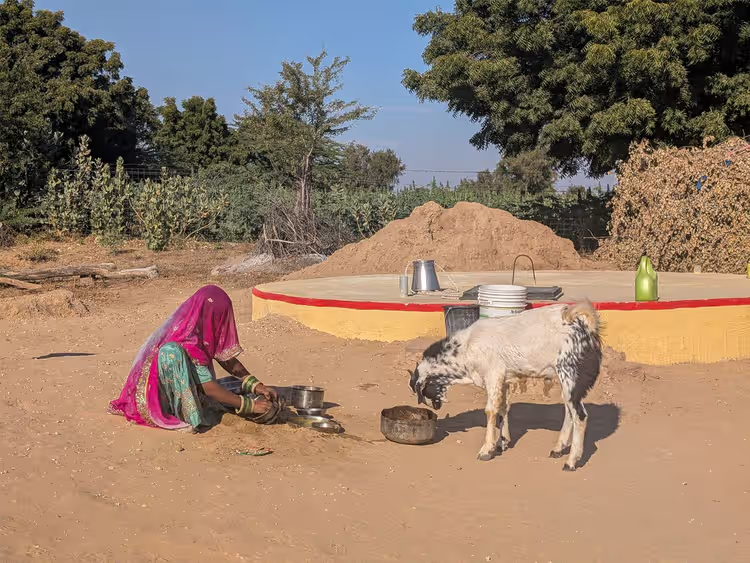
Vimala splashes a handful of Thar desert into one of the grimy bowls we have just eaten from. Rotating the vessel in her hands she scrubs off the leftover grains and grease. “With sand the dishes get cleaned well. With water, they don’t,” she speaks through her pink veil.
Why? I follow Vimala’s broken Hindi but haven’t understood her logic.
“The quantity of NaCl [Sodium chloride aka salt] is high in the water here,” my friend Pushpa Chouhan, 27, chimes in. She is Vimala’s sister-in-law and my translator for the day. “If we use water the stains remain on the dishes. The water here is bhari and khara [heavy and salty].”
Welcome to the world’s ninth largest subtropical desert. The salty taste of the groundwater has a geological explanation. The intensity of the evaporation here exceeds that of the rainfall. Thousands of years of this results in the salt and minerals getting deposited in the soil and water here. The desert spreads across Gujarat, Rajasthan, and the other side of the border to the regions of Punjab and Sind in Pakistan.
In the middle of this desert, in the newly formed (2023) Phalodi district of Rajasthan, lies the village of Daya Kor. At the edge of which is Vimala’s house. And right outside her residence sits Vimala Devi, 32, on her haunches, cleaning the vessels.
She belongs to the Meghwal community listed as a Scheduled Caste in the state. Traditionally the Meghwals farmed, reared cattle and wove clothes and blankets. But centuries of caste discrimination have kept the level of educational attainment and progress in the community at historically low levels.
Vimala’s husband, Kanwarlal, 36, dropped out of school as did his brother Bhojaram, 32, and worked as a labourer in the salt mines to ensure good quality education for their younger siblings. Kanwarlal, a landless Dalit farmer, now cultivates pearl millet, wheat, fenugreek, and groundnut on 40 bighas of leased land (here, 4 to 5 bighas makes an acre). Farming in Phalodi is a challenge with low and erratic rainfall, frequent drought, crop failure, poor yield.
In this arid region with about 200 millimetres average rainfall, water is a scarce and precious resource. The tiny splash that Vimala uses to unstick the hardened bits on the dishes is drawn from a tanka, an underground reservoir, next to the house.
The tanka has been a popular technique to fight water scarcity in the Thar desert, though a rather recent one compared to baoris (stepwells) and talabs (lakes). A 1988 booklet published by the Central Arid Zone Research Institute says that the earliest construction of tankas in this region was in 1607 A.D. by Raja Sursingh in village Vadi ka Melan. And later in 1759 A.D. in the Mehrangarh fort at Jodhpur by Maharaja Udaisingh. But it was during the great famine of 1895-96 that tanka were constructed on a wider scale in this region.
“Tankas were used to collect rainwater from the roof that is used for potable water. They are made from cement, concrete, and stone, and are commonly used in western Rajasthan,” says 19-year-old Badrinarayan Chouhan, Vimala’s nephew. “A tank that measures 10 feet in width and 20 feet in length, can collect around 56,000 to 58,000 litres of water. And building it costs approximately 50-80,000 rupees.”
Vimala’s family has two in their courtyard. An old one built in 2001 collects rainwater. And a rather new, bigger one holds up to 60,000 litres of water for their household needs. Today the tanka with the bigger capacity gets refilled with the water from the tankers that the family buys. Around 500 rupees for 5,000 litres. These tankers get their water from the nearby filtration plant at the Indira Gandhi canal, the longest in India. The canal in turn draws its water from Punjab’s Harike Barrage, where Sutlej and Beas rivers meet.
A 204-kilometre long Rajasthan feeder canal has reached Phalodi but not Kanwarlal’s farm. He relies on a borewell, which he says has started getting replenished after the coming of the canal. This artificial recharging of groundwater, though, is not solving Vimala’s challenges for potable water. That must be bought.
But things were worse until early 2000s when women had to fetch water from nearby ponds or wells. “Mother used to rise early to fetch water. Even before going to school, we had to help in the household chores,” recalls Pushpa. “I used to think if only there was water supply near our home or in our home we wouldn’t need to walk so far. And I could’ve used that time to learn an alphabet. That was when I studied in Class 1.”
The tankas in the community today have made harvesting rainwater possible, making drinking water easily available to people for the first time . Meghwals, being Dalit outcastes in the village, are systematically cut out of all common resources, including water from the village wells. Even while they constitute the largest population among the Scheduled Castes in Rajasthan (2011 Census), Meghwals remain most vulnerable to oppression and violence by dominant castes.
Daya Kor was different when I interned here in 2010. Back then switchboards hadn’t replaced the sooty kerosine-bottle-lamps of the room corners. We weren’t glued to our mobile screens. More recently, I found myself in a few conversations that drifted into us scrolling on our phones or discussing topics determined by the algorithms that filled our times.
The old taboo on meat-eating has disappeared, at least in Meghwal community in the past few years. During one of my recent visits, we ate mutton curry and bajre ke roti for lunch. Ghevarram, the head of our family, ate from one plate and the rest of us men ate jointly from another plate, like in the old times. Vimala must have her meal after we finish. Women still eat after all the men in the family have eaten. Some things haven’t changed.
The canals, tankas and the tankers may have eased the labour for women today. But the scarcity of water and the dangers of the harsh desert weather continue to determine how the living survive. There is a reason why the region of Thar is known as Marusthali, the land of death. The deadly desert fever, lou, still reigns.
In 2022 Phalodi recorded the highest officially verified temperature in the country at 51 degrees Celsius. The visuals of windmills catching fire under the sun in the region had gone viral just a while before that.
Many in the village, however, see things differently. Bhojaram, 32, sounds positive about the change. “Previously a person had to make a great effort just to scrape together one proper meal. Not any more. We produce nearly everything by our hands. Right here at home. Like wheat, coriander, and cumin – everything comes from the farm. And there is absolute purity in what we eat.”
But what about the heat?
“We are habituated to the climate. We don’t think much of the heat here,” he says. “It’s really nice. The area is good, environment is clean. Earlier there were lots of struggles. This water wasn’t there, these plants weren’t there, there wasn’t a place to keep the animals. How long do such high temperatures last? Just 5-7 days. But those days don’t make much difference.”
Though according to the New York Times’ interactive calculator, in the year Bhojaram was born Daya Kor saw about 240 hot days. While now the village sees 253 days a year of high temperatures. And by the time he turns 80, the village will see almost 260 to 277 blistering days.
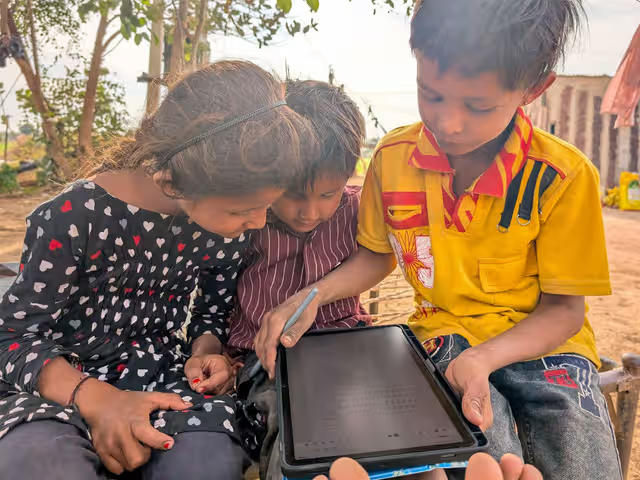
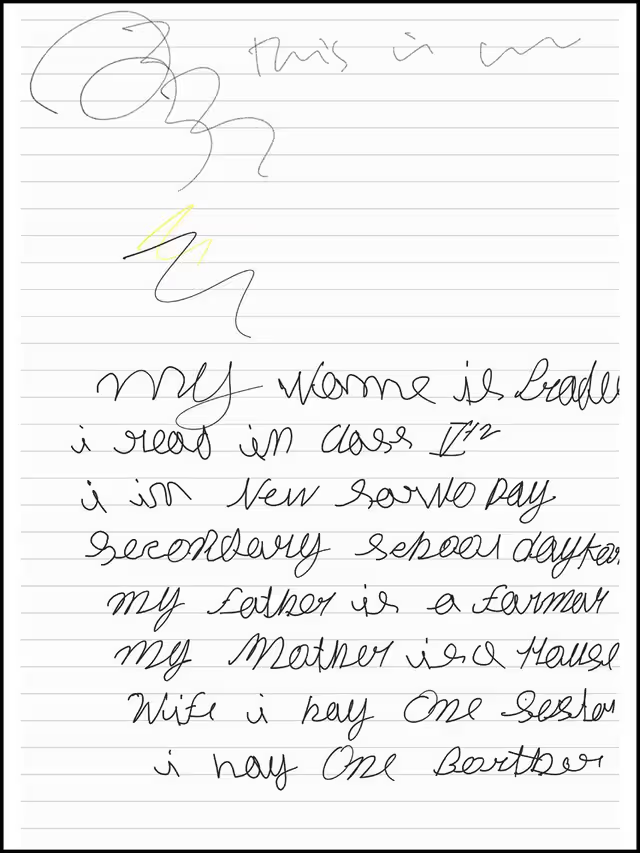
Vimala’s children Sonu and Pooja are scribbling shapes and alphabets on my notepad, as we talk. Pradeep, the eldest, writes English sentences he has learned at school. “My name is Pradeep. I have one sister. I have one brother. I read in Class 5. I in new Sarvoday secondary school Daya Kor. My father is a farmer. My mother is a housewife.”
I see Vimala at some distance away, toiling in the farm, with the winter sun is shining over her head.
In five months, those rare rain clouds will run across the sky above. The word “Meghwal” is derived from the two Sanskrit words, megh and wal, meaning people of the clouds. I have memories of children bursting into a rhyme they learnt from their grandfather Ghevarram, when the first few raindrops hit their skin.
Mei mei aaja, ghee roti khaaja
Mei mei aaja, ghee roti khaaja
[Here comes the rain, here comes the rain,
to eat roti with ghee, here comes the rain]